 Feedback Journey
Journey Cards: verifiable proof of client satisfaction
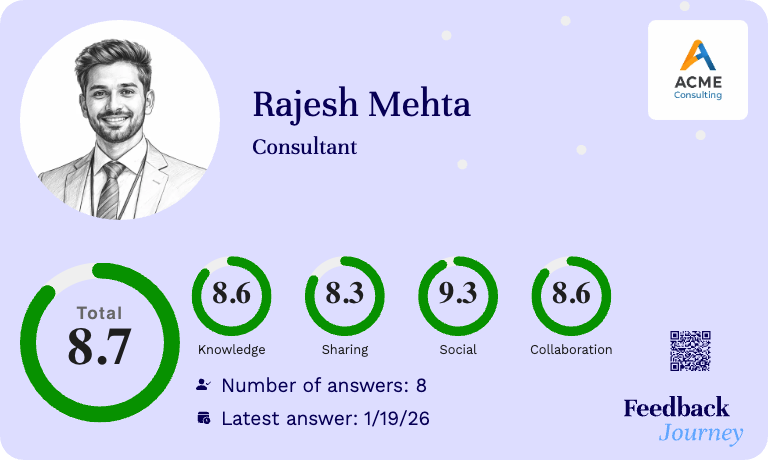
A Journey Card is a shareable summary of the real scores your clients gave you. It shows the average score for each of the four categories, how many people responded, and the date of the most recent response. A QR code on the card links back to the live results, so anyone holding a copy can check that it is genuine.
What is on a Journey Card?
- The average score for each of the four categories in the survey type.
- The number of people who responded across the surveys covered.
- The date of the latest response, so a reader can see how current it is.
- A QR code that opens the card on feedbackjourney.com for verification.
Why can a client trust a card you made yourself?
Because you cannot pick only your good surveys. A Journey Card covers a range: you choose a first and a last survey, and every survey in between is included automatically. A weak result inside that range stays in the average. The card also prints the responder count and the latest response date, so a thin or stale card looks thin and stale. That is the whole point.
How does the QR code verification work?
Every card carries a QR code that points at the same card on feedbackjourney.com. A client scans it and sees the live version next to the copy in their hand. No account is needed to look. If the numbers on paper differ from the numbers online, the client knows immediately.
Where should you use a Journey Card?
- In a proposal or tender, as evidence next to the claims you make.
- On your CV, where it gives a hiring manager data instead of adjectives.
- On LinkedIn or an Upwork profile, where buyers compare you with strangers.
- In printed material, where the QR code links the paper back to live results.
Why not just use testimonials?
A testimonial is chosen by the person it flatters. Nobody publishes the quote from the project that went badly, and readers know it, which is why glowing testimonials persuade so little. A Journey Card is a measurement rather than a quote. It reports what a defined group of clients actually scored, including the parts you would rather not show, and that is what makes the good parts believable.
Do Journey Cards help with ISO 9001?
They can help with the evidence. Clause 9.1.2 of ISO 9001:2015 requires an organization to monitor customers' perceptions of how well their needs and expectations have been met, and leaves the method open. A recurring survey with fixed questions produces exactly that kind of documented, reviewable record. Talk to your auditor about what they accept, but comparable scores over time and a dated Journey Card are a reasonable place to start.
How do you get your first card?
Run a survey, wait for the responses, then create a card from one or more completed surveys of the same type. Cards get stronger as you add surveys, because more responders and a recent date both make the result harder to dismiss. Pair the card with an improvement goal and the scores you publish should climb on purpose rather than by luck.